AdkAction offered Sustainable Winter Road Maintenance Training to highway departments and DOT residencies in Clinton, Essex, and Franklin Counties in April. The goal is to maintain safe roads during the winter months, but by using modified techniques, equipment and materials that require significantly less salt to reduce negative environmental impacts–and save money, too!
Sustainable Winter Maintenance Training
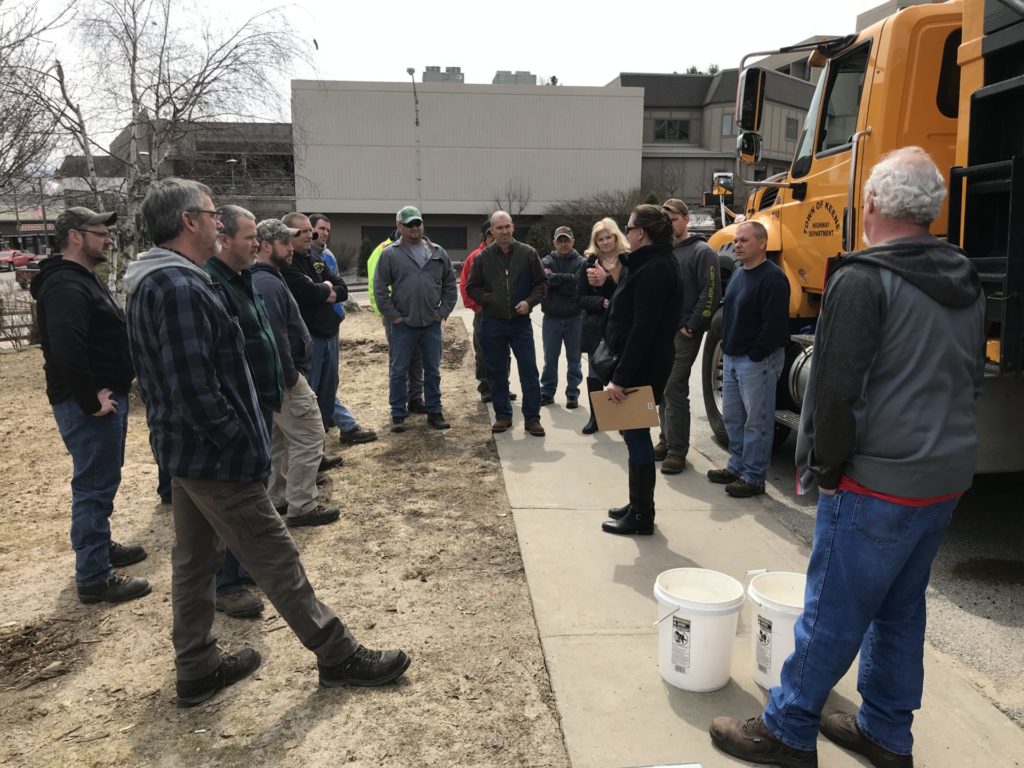
- During the week of April 8th, AdkAction offered three Sustainable Winter Maintenance Training workshops that were attended by forty-nine representatives from highway departments in Franklin, Clinton and Essex counties as well as the NYS Department of Transportation. The sessions were presented by Diana Clonch, a recognized winter road maintenance industry expert who has 30 years of experience and a diverse background in operations and management, and snow and ice control at the county, city and state levels, and Diane Watkins, retired Superintendent of Traffic and Roads Division for the city of Cincinnati, Ohio. Both women have spent many years working with local, regional and national groups promoting the advancement and application of best practices and innovative technology within operations for snow and ice control. Adoption of these practices generally result in an increased level of service, often accomplished with reduced expenditures.
- The morning session of the workshops provided an overall view of the various aspects of snow and ice control as related to management and supervision of operations, followed by information for operators in the field promoting Sustainable Winter Maintenance (SWiM) guidelines as a way to achieve consistent, reliable, and desired results on winter roads. An afternoon session provided a demonstration and training for the calibration of select snow removal equipment to enable control and monitoring of materials being applied to winter roadways.
The following summarizes some of the important information gathered from the forty participants, representing fourteen towns, villages, counties and the DOT, who completed surveys at the end of their training sessions.
- 49 attended the training sessions
- 3 towns, 1 county, and DOT currently use advanced plow technology
- 2 counties, 1 town and DOT currently calibrate equipment
- the average operator maintains 84 miles of roadway
- 8 towns and counties use sand and salt, 2 towns use sand, 1 county uses salt/treated salt, DOT uses sand, salt, treated salt, anti-icing and deicing brines
- new information to put into practice: 10/ reducing salt usage, 9/ calibration, 4/other information, 3/ wetting process
- participant rating of the usefulness of the winter road maintenance workshop: 8.5/10
This work was completed by AdkAction with funding from the Lake Champlain Basin Program as part of the 2 Tier Approach to Sustainable Winter Road Maintenance, in partnership with the Fund for Lake George.